
Sports Analytics Software Development Services, Built to Win
We build end-to-end sports analytics software, from real-time performance dashboards to AI-powered predictive models, purpose-built for how your organization actually operates.
Where Sports Organizations Lose The Analytics Advantage?
Most teams aren't losing because of bad athletes. They're losing because the systems meant to surface the right information, at the right moment, are failing them.

Data Silos
Player, medical, and tracking data live in disconnected systems. No single source of truth means analysts spend more time stitching exports than generating insight.

No Live Layer
Coaches need information during the match, not 48 hours after it. Without live data pipelines, analytics stays in the debrief room instead of the dugout.

Poor Tool Fit
Generic platforms are built for average use cases. Your sport, your data model, and your workflow rarely fit into someone else's product roadmap.

Generic AI
Machine learning models trained on generic data fail in sports environments. Predictions require sport-specific feature engineering, not out-of-the-box algorithms.
Meet Our Sports Expert: Rob Terry
Rob Terry, Director of Sports Sales – North America, is a sports industry expert leading Folio3 AI’s sports sales initiatives. With strong market insight and a client-first approach, he helps sports organizations adopt AI-driven solutions for analytics, performance improvement, fan engagement, and measurable business growth.
Sports Analytics Software Development Solutions We Deliver
Player Performance Analytics
Custom dashboards that surface per-player physical and technical KPIs across training, match, and recovery cycles, structured for analyst and coaching workflows.
AI Predictive Modeling
Bespoke machine learning models for match outcome prediction, player form forecasting, and tactical pattern recognition, trained on your historical data.
Video And Computer Vision
Automated event detection, player tracking, and positional analysis extracted directly from match footage, reducing manual tagging from hours to minutes.
Opponent Scouting Software
Structured scouting databases and automated report generation tools that turn raw opponent data into actionable pre-match intelligence for coaching staff.
Talent Identification Platforms
Data-driven recruitment systems that score prospects against performance benchmarks, integrate with scouting networks, and flag fit against squad needs.
Injury And Load Management
Workload monitoring systems that track cumulative training stress, flag injury risk thresholds, and integrate with medical team protocols to protect athlete availability.
Fan Engagement Analytics
Behavioral data platforms that track fan interactions across broadcast, app, and stadium touchpoints are used to personalize content and grow commercial revenue.
Sports Business Intelligence
Executive-level BI tools that combine on-field performance data with commercial, ticketing, and media metrics for ownership and board-level reporting.
How Do We Build Sports Analytics Software That Performs In Production?
Data Architecture First
Before any model or dashboard is touched, we map every data source, define the schema, and design the storage layer. Clean architecture prevents expensive rebuilds at scale.
Sport-Specific Model Training
We build and train models on sport-relevant features, like pitch zones, game states, position clusters, seasonal form cycles, not generic ML templates applied to sports data.
Real-Time Pipeline Engineering
Production pipelines are built for sub-second latency where it matters. Match-day infrastructure is tested under load before it ever sees a live event.
Analyst And Coach-Led Design
UI decisions are validated against the people who will use the system daily. We run structured sessions with analysts, coaches, and medical staff during design, not after launch.
Validated Before Deployment
Every model is backtested against historical data. Every pipeline is stress-tested under peak load. We do not ship systems that have not been validated against real conditions.
Integration Without Disruption
New systems connect to your existing data providers, video infrastructure, and internal tools through documented APIs and ETL pipelines, not manual workarounds.
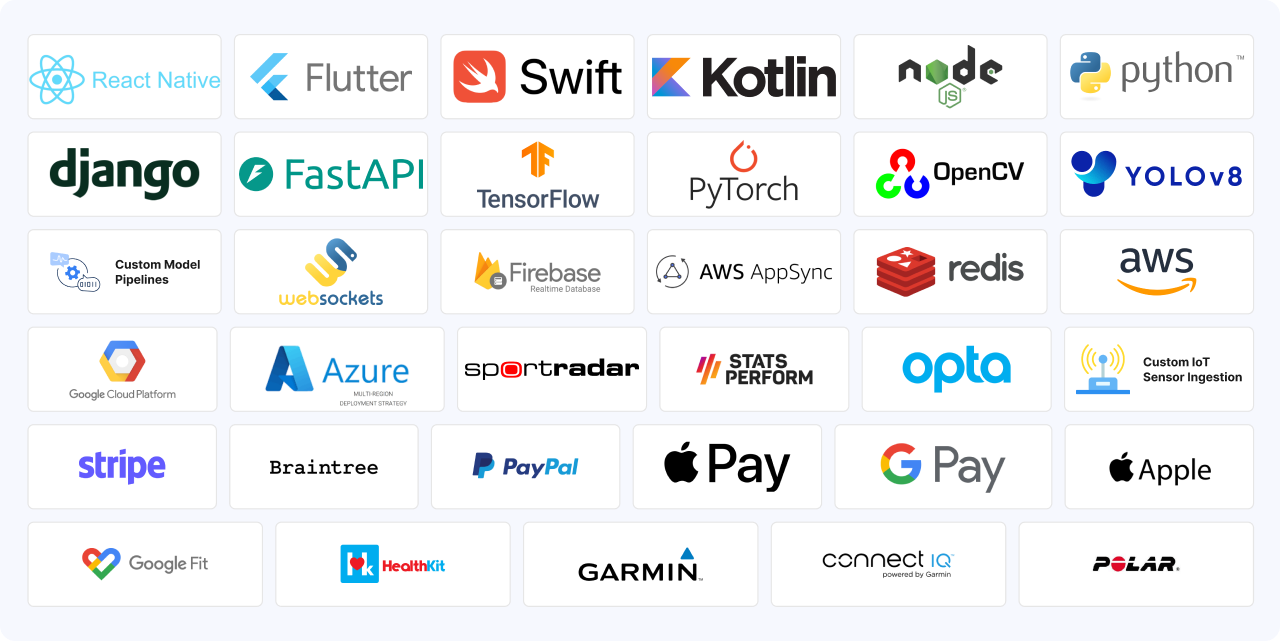
Technology Stack for Sports Analytics Software Development
Every technology choice is made for your sport, your scale, and your integration environment — not for convenience.
Our Sports Analytics Software Development Process

Data Audit And Source Mapping
We begin by inventorying every data source your organization owns or can access, tracking systems, APIs, video libraries, wearables, and third-party feeds.

Analytics Requirements
Working sessions with coaches, analysts, medical staff, and executives establish what decisions the system must support, what latency is required, and what outputs matter.

Architecture Design
The full system architecture, like storage layer, pipeline topology, model serving infrastructure, and access control design, is documented before a line of production code is written.

Data Engineering and ETL Build
Ingestion pipelines, transformation logic, and data quality monitoring are built and validated against real source data before model or UI development begins.

Model Development And Backtesting
ML models are built, tuned, and backtested against multi-season historical datasets. Performance benchmarks are agreed upon and met before any model moves toward production.

Dashboard And Interface Development
Analyst, coaching, and executive interfaces are built to the validated design spec, with iterative review sessions from the end users who will work in the system daily.

Integration And UAT
System connections to existing infrastructure, like video platforms, ERP, scheduling tools, and existing databases, are tested end-to-end under realistic data volumes and concurrent load.

Production Deployment And Monitoring
Launch includes automated alerting, pipeline health monitoring, model performance tracking, and documented runbooks so your internal team can operate the system confidently.
Why Do Sports Organizations Choose Folio3 As Their Analytics Development Partner?
AI At The Foundation
Analytics systems we build use machine learning as a core component, not a feature added to justify the budget. Every platform is designed for model integration from day one.
Sports Domain Expertise
Our team has built production systems across professional football, basketball, American football, rugby, baseball, and esports, with direct knowledge of how each sport's data differs.
Full Data Lifecycle Ownership
From raw sensor ingestion to the executive dashboard, we own the entire data pipeline. You don't need to coordinate between three vendors to get a working system.
Flexible Engagement Models
We work across fixed-scope builds, embedded team augmentation, and ongoing retainer relationships; structured around what your organization's stage and budget actually require.
Post-Deployment Model Maintenance
Machine learning models degrade as player populations, rules, and data distributions shift. We provide ongoing model retraining and performance monitoring after launch.
Unified Sports Intelligence For Every Stakeholder
A well-built analytics system doesn't serve one department. It creates a single source of truth that each function can access through the lens they actually need.
Head Coaches And Analysts
Live tactical dashboards, post-match breakdowns, and session planning tools that surface what the coaching team needs without requiring a data science degree to operate.
Sports Medicine And Performance
Athlete load monitoring, injury risk flagging, and recovery tracking tools integrated with medical records and physiotherapy workflows — not bolted on afterward.
Sporting Directors And Recruitment
Prospect databases, transfer market analytics, and squad gap analysis tools that give recruitment decision-makers data-backed justification for every signing.
Franchise Owners And Executives
Commercial performance dashboards that connect on-field results to revenue, fan engagement, sponsorship valuation, and long-term asset value reporting.
Broadcast And Media Partners
Real-time data feeds and graphics API integrations that power live statistics, second-screen experiences, and automated highlight generation during broadcasts.
Our Sports Analytics Software Development Process
Every project follows a structured delivery methodology that moves from data reality to production system, with validation checkpoints at every stage.
- Dedicated Sports Development TeamA full-time team of engineers, designers, QA specialists, architects, and project managers dedicated to your sports software roadmap.
- Fixed-Scope Project DeliveryBest for clearly defined products, MVPs, dashboards, integrations, or modules with fixed requirements, milestones, and launch timelines.
- Staff AugmentationAdd experienced sports software developers, AI engineers, data engineers, or mobile specialists to strengthen your internal team.
- Product Strategy & Technical AdvisoryGet senior product, architecture, AI, and integration guidance before major platform builds, modernization projects, or vendor transitions.
How We’ve Helped Sports Organizations Win
Helping Analysts Save Matchweek Hours
End-to-end analytics platform integrating GPS tracking, optical event data, and video tagging for a top-flight European club's first team and academy.
Outcomes:
73% reduction in analyst time spent on data preparation
Live match dashboard adopted by coaching staff within 3 weeks of launch
Injury risk model flagged 4 of 5 soft tissue injuries 6–9 days in advance
Powering the Second-Screen Experience
Real-time data infrastructure delivering sub-200ms statistics to broadcast graphics systems and a second-screen fan app across 82 regular-season games.
Outcomes:
99.97% pipeline uptime across the full regular season
Average data latency of 140ms from sensor capture to broadcast overlay
Second-screen app saw 41% higher session duration with real-time stats
Frequently Asked Questions
What is custom sports analytics software development?
It is the design and build of bespoke data systems that capture, process, and surface sports-specific insights tailored to a specific organization's workflows and data sources.
How is this different from buying a platform like Catapult or Hudl?
Off-the-shelf tools standardize workflows to fit their product. Custom development builds the system around your data model, sport, and internal processes — with no feature compromise.
What data sources can you integrate into a sports analytics system?
We integrate wearable sensors, GPS and optical tracking, video feeds, third-party data providers (Sportradar, Opta, Stats Perform), ERP systems, scheduling tools, and proprietary databases.
Can you build AI models for injury prediction and player performance forecasting?
Yes. We develop, train, and validate sport-specific machine learning models for injury risk, performance trajectory, load management, and match outcome prediction using your historical data.
How do you handle athlete health data privacy and compliance?
All health data handling follows HIPAA-aligned protocols, with role-based access controls, data encryption at rest and in transit, and audit logging — structured for sports medical compliance requirements.
Do you work with organizations that already have some analytics infrastructure?
Yes. Most engagements involve existing data providers or internal tools. We audit what is in place, identify integration points, and build around existing infrastructure rather than replacing it wholesale.
What makes Folio3 a qualified sports analytics software development company?
We have built production analytics systems across professional football, basketball, baseball, rugby, and esports — combining AI/ML engineering with domain knowledge of how sports data actually behaves.
Can the system be used by coaches and medical staff who are not data specialists?
Yes. Interface design is co-developed with the coaches, analysts, and medical staff who will use it. Usability for non-technical users is a delivery requirement, not an afterthought.
What ongoing support do you provide after the system launches?
Post-launch support includes model retraining, pipeline monitoring, feature updates, and performance reporting — structured as a retainer or on-demand engagement depending on your team's needs.
Build analytics that gives you the edge
Most sports tech fails when data can’t lead to fast decisions. Start the conversation if your setup holds teams back.

